Frame the work
A guided dialogue turns a written need into a dated plan. Nothing is generated until a person approves it.
SynACX is a platform for steering software delivery with AI agents.
For teams and agencies that develop with Claude Code or Codex, on GitHub (or your own Git server) and ClickUp.
Installed on your own server: your projects and your secrets stay there. Only what an AI feature needs goes to the AI provider of your choice.

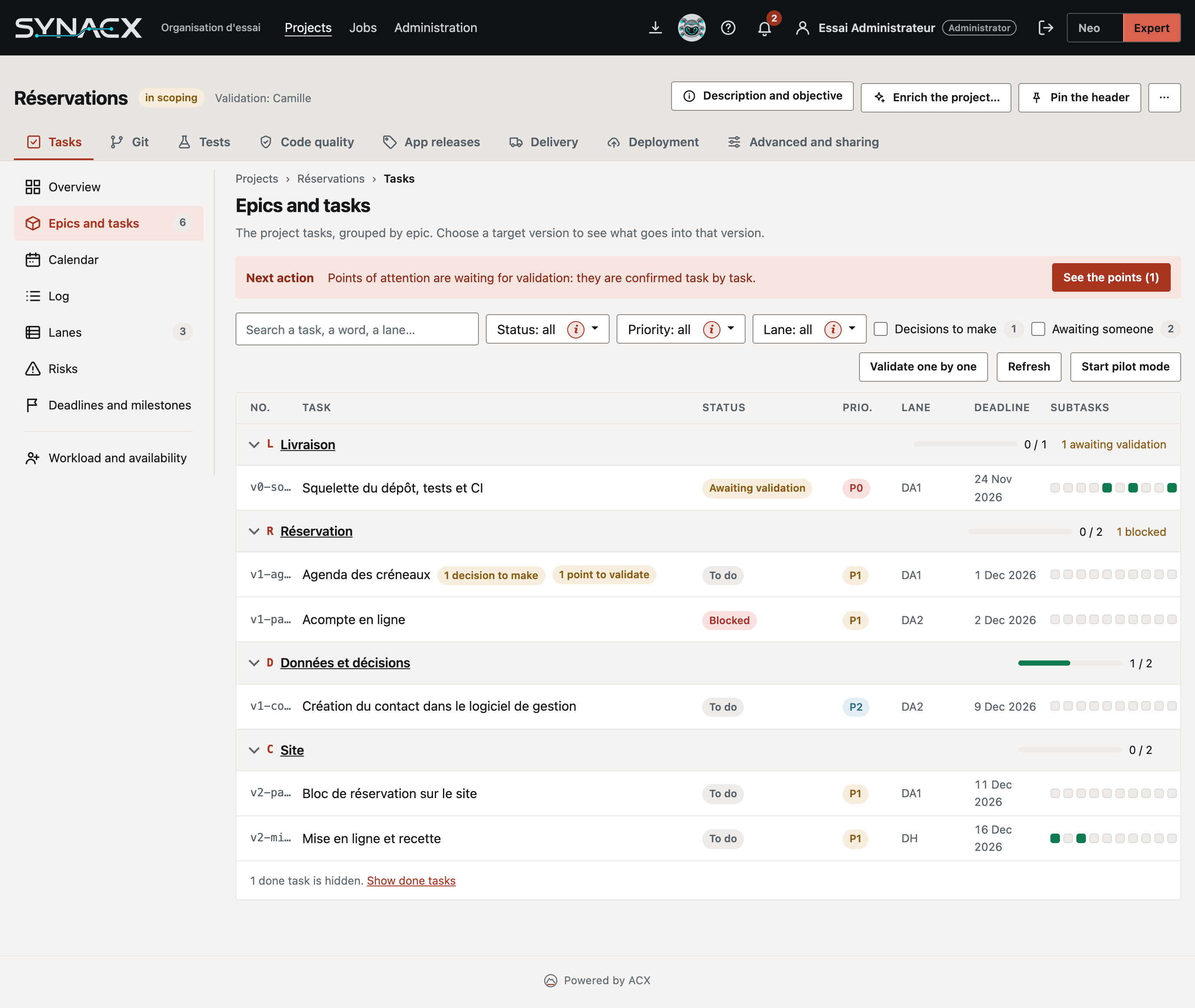
The Tasks tab of a project in SynACX 1.2.1: a real screenshot, on a sample project.
Frame the need with the AI, then approve a dated plan.
Claude Code or Codex works with the project’s context and rules.
Commits, tests and code quality, measured — not declared.
Sealed releases, and a production GO that stays human.
Why SynACX
Getting an AI to produce code has become easy. Framing it, tying it to a backlog, knowing what is actually done, proving it and delivering it without breaking anything: that is where projects get lost.
A guided dialogue turns a written need into a dated plan. Nothing is generated until a person approves it.
Claude Code or Codex receives the project, the current task, its rules and its guard rails — no more pasting context by hand.
Commits, test results and coverage are reported by the machines. A task is not marked done without its proof of tests.
The AI proposes, measures and drafts. Approvals and the production GO are always a person’s act.
Sealed releases, a versioned delivery strategy and deployment plans computed before any action — carried out on your machines, never by the server.
Not intentions: behaviours, held by tests, that no setting can lift.
SynACX installs on your own server: your projects and your secrets stay there, your code in your Git repository. Only what an AI feature needs — instructions, texts, code excerpts — goes to the AI provider you choose, on your key, and never a key from the vault; your development agent talks to it from your machines, under your account. A company's secrets are encrypted in the database, and the service refuses to start without its key.
A disabled integration says so. A failure keeps its trace. A refused action gives its reason. There is no quiet fallback that would make a failure look like a success.
Every job records what it creates as it goes. A rerun picks up where it stopped and never creates the same task, repository or ticket twice.
The AI proposes, measures, drafts. It does not give the GO and does not deploy to production. Even in a Nyx project, where it makes the technical choices, the framing, production and the sensitive decisions stay with a person. A protection is never configured from the screen it protects.
SynACX is used by ACX to run its own projects and those of its clients, and is installed at a client in production use. It is built with itself: its roadmap, its work items and its deliveries live in a SynACX instance.
One hour, your real project, your backlog. We frame it together, SynACX generates, and you see what it gives on your own data — not on a prepared demonstration.
